Why Custom Web Design Elevates Local Aussie Business
Why Custom Web Design Elevates Local Aussie Business

Finding new customers in Melbourne or Sydney can be tough when your online presence feels generic or outdated. Australian trades and local services need more than just a basic website to stand out in their communities. By investing in a personalised digital presence through custom web design, you give your business the professionalism, credibility, and local appeal needed to attract and win clients across Australia.
Table of Contents
Key Takeaways
| Point | Details |
|---|---|
| Custom Web Design Enhances Brand Identity | Tailoring your website to reflect your unique business values creates a stronger brand presence and builds customer trust. |
| Selecting the Right Website Solution Matters | Understanding your business model will help you choose the most suitable type of website for your needs, from e-commerce to informational sites. |
| Responsive and User-Friendly Design is Crucial | A well-optimised website prioritises user experience, leading to better engagement and increased conversions. |
| Investing in Quality SEO is Essential | Mobile optimisation and search engine strategies significantly improve your site’s visibility and attract local customers effectively. |
Defining custom web design for small business
Custom web design isn’t just about creating a website—it’s about crafting a digital storefront that tells the unique story of your local Australian business. For small business owners in Melbourne, Sydney, or regional towns, a personalised digital presence can transform how potential customers perceive and interact with your brand.
The core philosophy of custom web design centres on tailoring every visual and functional element to match your specific business needs. Unlike generic template websites, a custom design approach ensures your online platform reflects your brand’s personality, values, and service offerings precisely.
Key characteristics of custom web design for small businesses include:
- Unique visual branding that matches your company’s aesthetic
- Responsive design optimised for mobile and desktop users
- Intuitive navigation specific to your service offerings
- Fast loading speeds customised for your content
- Strategic placement of contact information and call-to-action buttons
When implemented effectively, custom web design goes beyond mere aesthetics. It becomes a powerful marketing tool that communicates professionalism, builds trust, and helps potential clients understand exactly what makes your business special.
Pro tip: When investing in custom web design, prioritise functionality and user experience over complex graphics that might slow down your website.
Types of website solutions and key differences
Small businesses in Australia have multiple website solutions available, each designed to meet specific digital marketing and operational needs. Different website types serve unique purposes, ranging from simple informational platforms to complex e-commerce systems that can transform how local businesses interact with customers.
The primary website solutions for Australian small businesses typically include:
- Informational websites : Basic platforms showcasing business details, services, and contact information
- E-commerce websites : Online stores enabling direct product sales and transactions
- Portfolio websites : Visual showcases for service-based businesses like tradies, designers, and consultants
- Blog websites : Content-driven platforms for sharing industry insights and building thought leadership
- Booking/Service websites : Specialised sites with integrated appointment scheduling systems
Each website type offers distinct advantages depending on your business model. An electrician might prioritise a straightforward informational site with clear service descriptions, while a boutique fashion retailer would benefit from a robust e-commerce platform with high-quality product imagery and secure payment integration.
Here’s a side-by-side view of how different website types serve varied small business needs in Australia:
| Website Type | Ideal For | Common Features | Business Impact |
|---|---|---|---|
| Informational | Local services and tradies | Service summaries, contact info | Builds trust and credibility |
| E-commerce | Retailers and boutiques | Product catalogues, secure payments | Enables direct online sales |
| Portfolio | Designers, consultants | Past work display, testimonials | Attracts new clients visually |
| Blog | Industry experts, specialists | Articles, social sharing | Grows authority, drives traffic |
| Booking/Service | Cafes, salons, trades | Online scheduling, payment options | Streamlines customer bookings |
Choosing the right website solution requires understanding your specific business goals, target audience, and desired customer interaction. Consider factors like budget, technical complexity, and potential for future expansion when selecting your digital platform.
Pro tip: Select a website solution that not only meets your current needs but allows scalable growth as your business evolves.
Unique branding and customer trust online
In today’s digital marketplace, building a robust online brand identity is more crucial than ever for Australian small businesses. Consumer-brand engagement directly influences customer loyalty and determines how potential clients perceive your business’s professionalism and reliability.
Key elements that contribute to establishing trust and unique branding online include:
- Consistent visual design across all digital platforms
- Clear and authentic messaging that reflects your business values
- High-quality, professionally captured imagery
- Transparent contact information and business credentials
- Genuine customer testimonials and reviews
- Responsive and user-friendly website design
Modern consumers, particularly younger generations like Generation Z, are increasingly sophisticated in their digital interactions. They seek businesses that not only provide quality services but also demonstrate authenticity and reliability through their online presence.
Unique branding goes beyond mere aesthetics—it’s about creating a compelling digital narrative that resonates with your target audience. By investing in a carefully crafted online identity, small businesses can differentiate themselves from competitors and build meaningful connections with potential customers.
Pro tip: Invest in professional photography and consistent branding elements to create a memorable and trustworthy online image.
Tailored user experience and usability benefits
Custom web design transforms how small Australian businesses interact with their digital audience through strategic user experience (UX) optimisation. Custom user experiences prioritise personalised interactions that make website navigation intuitive and engaging for potential customers.
Key usability benefits for small businesses include:
- Faster loading times across mobile and desktop platforms
- Intuitive navigation tailored to specific business services
- Clear call-to-action buttons that improve conversion rates
- Seamless integration of contact and booking functionalities
- Device-responsive design that works perfectly on smartphones and tablets
- Accessibility features that accommodate diverse user needs
A well-designed website does more than look good—it creates a smooth, frictionless journey for potential clients. For instance, a local plumber’s website might feature easy-to-find emergency contact buttons, while a boutique cafe could integrate online booking directly into their homepage design.

Understanding and implementing user-centric design principles means creating digital experiences that not only attract customers but also encourage them to stay, explore, and ultimately engage with your business.
Pro tip: Conduct user testing with real customers to identify and eliminate any potential navigation or interaction barriers on your website.
SEO, mobile, and performance advantages
Australian small businesses can dramatically improve their online visibility through strategic mobile-optimised web design that prioritises search engine performance. Mobile optimization strategies are critical for capturing local market attention and improving search rankings in an increasingly digital landscape.
Key SEO and performance advantages include:
- Faster website loading speeds across all devices
- Improved mobile search engine rankings
- Reduced bounce rates from mobile users
- Enhanced local search visibility
- Better user engagement metrics
- Increased conversion potential for mobile visitors
Google’s mobile-first indexing means that websites not optimised for smartphones and tablets will effectively become invisible to potential customers. A custom web design approach ensures your digital presence is not just functional, but strategically crafted to meet modern search engine requirements and user expectations.
For local businesses like plumbers, electricians, and cafes, mobile optimization isn’t just a technical detail—it’s a critical marketing strategy that can mean the difference between being found or overlooked by potential customers searching for services in their local area.
Pro tip: Regularly test your website’s mobile performance using free tools like Google’s PageSpeed Insights to identify and address potential optimization opportunities.
Comparing custom design with templates in Australia
For Australian small businesses, choosing between a custom web design and a template solution can significantly impact their digital marketing effectiveness. Local website design strategies reveal crucial differences that can make or break a business’s online presence.
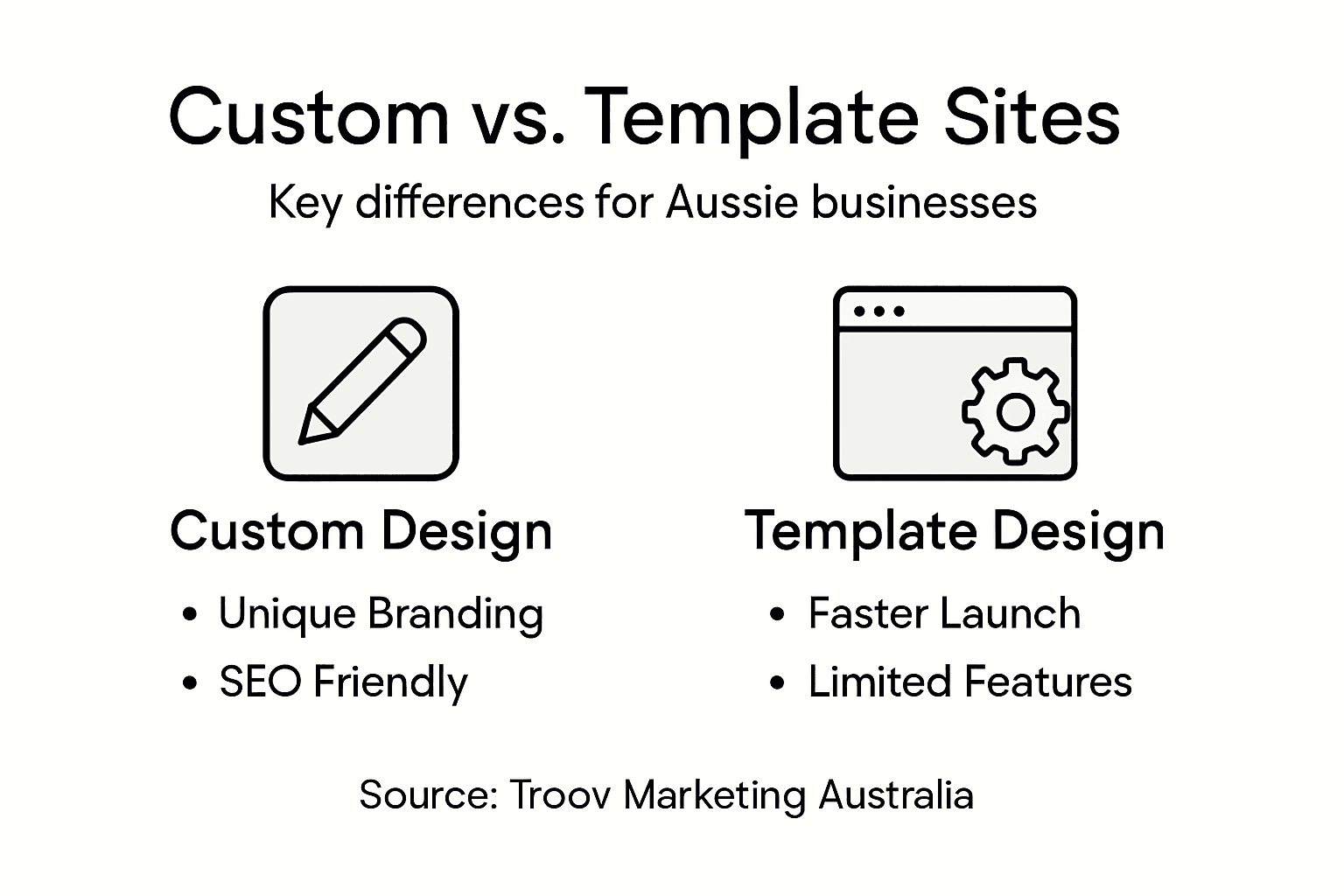
Key differences between custom design and template websites include:
Compare how custom web design differs from templates for Australian small businesses:
| Aspect | Custom Web Design | Template Website |
|---|---|---|
| Initial Cost | Higher upfront investment | Lower initial cost |
| Brand Identity | Fully bespoke branding | Generic, limited customisation |
| Scalability | Easily adapts to growth | Restricted by template limits |
| SEO Potential | Optimised for local search | May lack tailored SEO features |
- Flexibility : Custom designs offer unlimited customisation options
- Branding : Tailored designs accurately reflect unique business personality
- Performance : Custom sites typically load faster and rank better in search results
- Functionality : Specific business needs can be precisely integrated
- Scalability : Custom websites grow more seamlessly with business evolution
- Competitive Advantage : Unique design helps businesses stand out from competitors
Template websites might seem cost-effective initially, but they often limit a business’s ability to create a distinctive online identity. A local tradie in Melbourne, for instance, needs a website that showcases their specific services, work history, and local credentials—something a generic template cannot effectively communicate.
The investment in custom web design goes beyond aesthetics; it’s about creating a digital platform that authentically represents your business, connects with your target audience, and drives meaningful customer engagement.
Pro tip: Choose a web design approach that prioritises your specific business goals and target market over generic, one-size-fits-all solutions.
Elevate Your Local Australian Business with Custom Web Design
Many small business owners face the challenge of standing out in a crowded digital marketplace. The article highlights key issues such as creating a unique brand identity , improving user experience , and ensuring mobile optimisation to build trust and attract loyal local customers. If you feel your current website looks generic or fails to convert visitors into customers this is where a tailored approach can make all the difference.
At Troov Marketing , we specialise as a Small Business Web Designer focused on helping Australian businesses craft customised websites that reflect their brand personality and meet specific goals like faster loading times, strategic SEO, and seamless mobile performance. Our expertise aligns perfectly with the article’s emphasis on bespoke solutions that offer scalability and competitive advantage over template designs.
Take control of your online presence today and explore how custom web design can transform your business impact.
Ready to stand out locally and build trust with your customers?
Discover tailored solutions designed for your small business success by visiting Troov Marketing. Don’t settle for generic when you can have a website built just for you. Start your journey now and see how a personalised digital platform can grow your customer base and elevate your brand above the competition.
Frequently Asked Questions
What is custom web design, and how does it benefit local businesses?
Custom web design is a tailored approach to creating websites that reflect the unique identity and goals of a business. For local businesses, it enhances brand visibility, improves user experience, and helps engage customers effectively, ultimately driving sales and building trust.
How does custom web design improve SEO for small businesses?
Custom web design optimises websites for search engines by ensuring faster loading speeds, mobile responsiveness, and tailored content. This results in improved search engine rankings and better visibility for potential customers searching for services.
What are the main differences between custom web design and template websites?
Custom web design offers bespoke branding, scalability, and enhanced SEO potential, while template websites provide limited customisation and may lack specific features for unique business needs. Custom designs better represent a brand’s identity and can evolve with the business.
Why is user experience important in custom web design?
User experience is crucial because a well-designed website facilitates easy navigation, encourages longer visits, and boosts customer engagement. By prioritising user-centric design, businesses can improve conversion rates and customer satisfaction.
Recommended



 makes lazy loading work. Users benefit from fewer network requests, faster initial loads, and saved bandwidth. 4. Minify CSS, HTML, and JavaScript Code minification strips out extra characters like whitespace, comments, and line breaks while keeping functionality intact. Files can shrink by 20-50% or more. CSS Minifier, JSCompress, and HTMLMinifier make this task easy. Bigger projects should use build tools like Webpack, Gulp, or Terser to automate minification for every deployment. 5. Use a Content Delivery Network (CDN) CDNs put your content on servers worldwide and serve it from locations closest to users. Pages load up to 50% faster with less latency. CDNs do more than speed things up - they make sites more reliable through redundancy, lower bandwidth costs with cached content, and guard against DDoS attacks by handling traffic spikes. 6. Preload critical content Browsers can grab important resources early when you tell them what to preload, before they'd normally find them during parsing. Critical assets like hero images and fonts needin your HTML head. This works great for resources that browsers would find late otherwise, such as fonts in CSS files or critical JavaScript. Just don't preload too much - stick to 3-4 resources to keep browsers running smoothly. 7. Subset and optimize fonts Font files often carry unused glyphs that add unnecessary weight. You can dramatically cut font sizes through subsetting - some drop from 139KB to just 15KB. WOFF2 format compresses 30% better than WOFF. Websites serving multiple languages should use unicode-range to deliver just the needed character sets. 8. Remove unnecessary third-party plugins Unused plugins waste resources and might create security holes. Even inactive plugins can slow things down by bloating your database. You should check your plugins regularly and remove the ones you don't use. The cleanup should include deleting associated database rows to prevent orphaned data from dragging down your site's performance. Conclusion Website speed is one of the most important factors that affect your online business success. This piece shows how small delays can drastically affect user behavior and your revenue. The numbers tell the story—conversions drop by 7% with just a one-second delay, and bounce rates double after just 4 seconds. These statistics matter because they represent real customers and actual sales your business might be losing now. Your website is your digital storefront, and people form first impressions almost instantly. Users judge your credibility within milliseconds, definitely before they read any of your carefully crafted content. Mobile optimization needs special attention because mobile users are nowhere near as patient as desktop visitors. More than half of all web traffic now comes from mobile devices, so meeting their unique needs is a vital part of staying competitive. You now have solid techniques to fix speed issues, beyond just understanding the problem. Each strategy provides great performance benefits—from implementing proper caching and optimizing images to making use of lazy loading and removing unnecessary plugins. These techniques work together to improve your Core Web Vitals scores, which associate directly with better user experiences and higher conversion rates. Note that speed optimization should be an ongoing part of your website maintenance strategy instead of a one-time fix. Technologies evolve, user expectations increase, and websites naturally become more complex over time. Regular testing with tools like PageSpeed Insights and GTmetrix helps your site perform at its best. The message is clear—website speed directly affects your profits. Fast-loading websites create happy visitors who stay longer, buy more, and return often. Slow websites drive potential customers away quietly. The choice is clear, yet many businesses don't deal very well with this vital aspect of online presence. Will you let website speed kill your sales, or will you use these optimization techniques to outperform your competitors? Key Takeaways Website speed directly impacts your revenue, with even small delays causing significant losses in conversions and customer satisfaction. Here are the critical insights every business owner needs to know: • Every second counts : A 1-second delay reduces conversions by 7%, while pages loading in 2.4 seconds achieve 1.9% conversion rates versus less than 1% at 4.2 seconds. • Mobile users are less forgiving : 53% of mobile visitors abandon sites taking longer than 3 seconds to load, making mobile optimization crucial for business success. • First impressions form instantly : Users judge your website's credibility within 50 milliseconds, and 79% won't return after experiencing poor performance. • Proven optimization techniques deliver results : Implementing caching, image compression, lazy loading, and CDNs can dramatically improve speed and boost revenue by thousands annually. • Real-world success stories prove ROI : Walmart gained 2% more conversions per second of improvement, while Rakuten achieved a 33% conversion increase through Core Web Vitals optimization. The financial impact is undeniable—retailers lose $3.98 billion annually due to slow websites. By prioritizing speed optimization using tools like PageSpeed Insights and focusing on Core Web Vitals, you can transform lost visitors into loyal customers and significantly increase your bottom line. FAQs Q1. How does website speed impact sales? Website speed directly affects sales, with a 1-second delay potentially reducing conversions by 7%. Faster-loading pages have higher conversion rates, with pages loading in 2.4 seconds achieving a 1.9% conversion rate compared to less than 1% for pages loading in 4.2 seconds. Q2. Why are mobile users more sensitive to website speed? Mobile users have less patience for slow-loading sites, with 53% abandoning websites that take longer than 3 seconds to load. This sensitivity is crucial as mobile traffic now accounts for over half of all web visits, making mobile optimization essential for business success. Q3. How quickly do users form impressions about a website? Users form judgments about a website's credibility within just 50 milliseconds of viewing it. This rapid assessment means that website speed plays a crucial role in shaping first impressions and influencing whether visitors will stay or leave. Q4. What are some effective techniques to improve website speed? Key techniques for improving website speed include implementing caching, optimizing images, using lazy loading for media, minifying CSS, HTML, and JavaScript, utilizing a Content Delivery Network (CDN), and removing unnecessary third-party plugins. Q5. How can businesses measure and monitor their website speed? Businesses can use tools like PageSpeed Insights, GTmetrix, and Lighthouse to measure and monitor their website speed. These tools provide both lab and field data, offering insights into Core Web Vitals metrics such as Largest Contentful Paint (LCP), Interaction to Next Paint (INP), and Cumulative Layout Shift (CLS).